
Borrowed Light

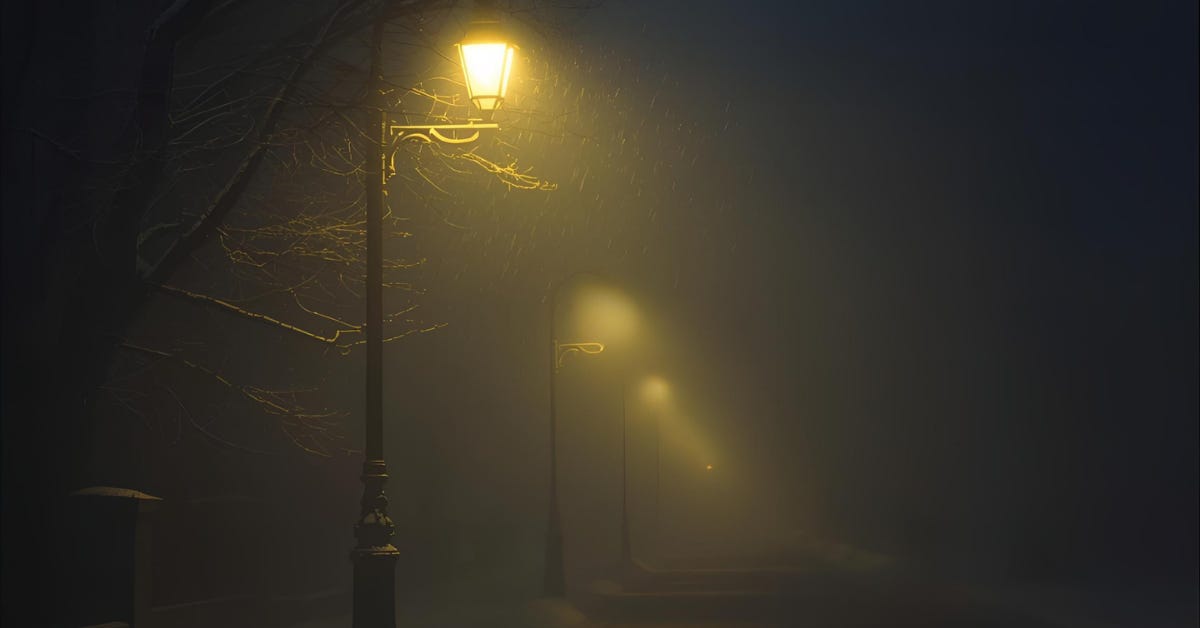
Winter has a way of softening the world - the light, the air, even the truths we carry.
Today I wanted to share a small story about a town where the lampposts dim each winter… all except one.
A lamppost that becomes a gathering place for quiet confessions, shared heaviness, and borrowed hope.
If you’re moving through a tender season, I hope this story offers you a little warmth - the kind you don’t have to earn, only step into. ❄️
Every winter, the town’s lampposts dim.
It happens slowly, like a sigh that starts in December and finally settles by mid-January. The bulbs flicker, soften, and then surrender into a dull glow that barely keeps the sidewalks lit. People complain about it from time to time, but mostly they accept it – winter here always asks everything and gives very little back, as if the season itself is grieving some ancient loss.
Except for one lamppost.
It stands at the end of Weller Street, next to the bakery that smells like cinnamon on Saturdays and nothing at all the rest of the week. While the rest of the town dims, this lamppost stays bright. Not harsh or clinical – the glow is warm, soft around the edges, almost like candlelight behind frosted glass.
No one knows why it stays bright, and no one tries to fix it. The town has decided, in the quiet way towns do, that it’s better not to ask too many questions. Rumors whisper of a long-ago accident, a worker who fell while repairing it during a storm, his final breath mingling with the wires. But those are just stories, or so they say.
And every year, the broken-hearted begin gathering beneath it.
At first, it’s accidental: someone waiting for the bus just a little longer than necessary; a shift worker taking the long route home so they can walk through the only patch of light that still feels alive, chasing away the shadows of their regrets.
Soon, it’s intentional.
People stand there with their shoulders hunched against the cold, hands stuffed deep in pockets, pretending they just happen to be lingering in that exact spot. But little by little, someone speaks. Then someone else answers.
The conversations start small:
“I’m so tired lately.”
“I know. Me too.”
“Feels like the cold got inside my bones this year.”
Then the stories deepen, laced with the weight of unspoken tragedies.
A single mother admits she’s been choosing between groceries and the electric bill ever since her husband vanished one icy night, leaving her with a child who asks for him in whispers before bed.
A teenager says he feels like he’s disappearing at school, his days blurred by the memory of a best friend lost to a car crash on these very streets last winter.
An older man confesses that he hasn’t heard from his kids all winter – hasn’t heard from them in years, really – after a family rift that started with harsh words and ended with doors slammed forever, pretending it doesn’t hurt is becoming impossible as his health fades.
People don’t rush to comfort or fix anything – they simply listen, their own scars aching in sympathy.
And somehow, that’s enough.
The lamppost seems to listen too.
Its glow shifts sometimes. Only a little. Just enough that if someone happened to be crying, they might whisper, “Did it… get warmer?” And someone beside them might gently say, “Maybe it did.” Or perhaps it’s just the wind, carrying echoes of voices long gone.
One bitter night in late January, a woman named Eira arrives. She’s well known in town for her pies, her bright laugh that now rings hollow, and the way she always waves at traffic even when she doesn’t know who’s driving.
But tonight, she looks smaller, shattered.
Her sister’s in the hospital again, this time with a diagnosis that whispers of finality, a relapse from the illness that stole their parents years ago. Eira has been her only caretaker, sacrificing dreams of her own family for endless hospital vigils.
She stands beneath the lamppost for a long time before she speaks.
“I keep telling everyone I’m fine,” she says finally, voice tight. “But I’m not. I’m terrified she’ll leave me alone in this world.”
The group doesn’t rush toward her – no one breaks the unspoken rule of the space. Instead, they shift just enough to make room. A widening of the circle. A soft acknowledgment: You belong here too, with your fractures and fears.
Eira lets out a breath that sounds almost like a sob.
The lamppost brightens, casting shadows that dance like forgotten memories.
Another night, a teenage girl brings her sketchbook and begins drawing the people who gather. She doesn’t ask permission; she simply sketches quietly, her breath fogging the air. Orphaned young by a fire that claimed her home and family, she’s lived in foster care ever since, her art the only anchor in a sea of transience. When she shyly shows her pages, the group sees she has drawn them not as they look – tired, bundled, fragile – but as if light is blooming out of their chests, piercing through the cracks of their sorrow.
“Why like this?” someone asks.
She shrugs, eyes distant. “Because that’s how it feels – like we’re all leaking light from the places we’ve been broken.”
The lamppost glows warmly behind her, almost as if agreeing, or perhaps revealing something hidden in its own steady flame.
As winter deepens, the gatherings grow. People bring thermoses of tea, spare mittens, a scarf left out for anyone who needs one. Someone strings paper stars along the nearby fence, each one inscribed with a silent wish. Someone else leaves a basket of hand warmers with a note: Take what you need. Leave what you can.
In the sharing, their tragedies weave together, forming a fragile tapestry of resilience.
The lamppost becomes less of a mystery and more of a meeting place.
A winter hearth.
A gentle anchor for the adrift.
One night, a widower named Elias – who has come every winter for three years, ever since his wife succumbed to a lingering illness that began under this very light – finally speaks aloud what he has never said.
“My wife used to stand with me here,” he murmurs. “She loved this lamppost. Thought it was watching over us, a guardian against the dark. I wasn’t sure I’d survive another winter without her – without anyone. The loneliness… it’s like drowning in silence.”
No one touches him. No one needs to.
But every person there breathes with him, slowly and steadily, until his shoulders settle and something inside him eases, as if the light has absorbed a fraction of his grief.
The lamppost shines brighter than any of them have ever seen, illuminating faces etched with shared pain, yet softened by connection.
By February, something unexpected happens.
The other lampposts in town – the ones that are always dim – begin glowing a bit stronger. A bit steadier. Not bright, but better. The power company shrugs and cites voltage stabilization. The locals don’t bother arguing.
They know the truth is simpler, quieter – light spreads, especially when people share theirs, even from the depths of their despair.
When spring finally arrives and the evenings stretch long again, the gatherings stop. People go back to their routines, their warm houses, their ordinary lives – though forever changed, carrying embers of that shared warmth.
The lamppost dims at last, joining the others.
But no one worries.
They know that next winter, when the world feels heavy again, the lamppost on Weller Street will glow bright – and they’ll gather, open-handed and open-hearted, beneath its gentle light.
Yet on the last night before it fades, as the final few linger, a faint whisper seems to emanate from the bulb itself, like a voice from another time: “I was once like you.”
And though they dismiss it as the wind, a mystery lingers in their hearts, a promise that some lights are kindled by sorrow, and in sharing it, they illuminate paths unseen.
Thank you for spending a bit of your winter evening here with me.
If you’ve ever stood in a place - real or imagined - and felt held by it, even for a moment, I’d love to know.
Your stories are safe with me. Always. ❄️🤍

✨ If this piece resonated, I also wrote a reflection inspired by Borrowed Light.
✧ There’s also a printable inspired by Borrowed Light for those who like to keep small rituals close. You can find it here.
I love this!
I’m speechless… this was just a beautiful story, the warmth of community, with the perspective of an object being the watcher of a shall town… I mean definitely a great write, ✍️ 👏👏👏👏👏